How to choose the perfect honeymoon destination in france for your travel style and budget
Planning your honeymoon in France is exciting… until you realise there are too many incredible places to choose from. Paris? Provence? The Riviera? A château in the Loire? A road trip in Normandy? With a limited budget and days off, the choice can quickly become overwhelming.
The good news: there is no single “best” honeymoon destination in France. There is only the one that matches your travel style, your budget and your timing. In this guide, I’ll walk you through a simple method to choose the right place for you, with concrete examples, realistic budgets and ready-to-use checklists.
Start with your couple travel style (not the Instagram photos)
Before listing destinations, be very honest about what you two actually enjoy on holiday. Forget what a honeymoon “should” look like. Ask yourselves:
- Do we recharge more by resting by the pool or by visiting and moving around?
- Are we more city lovers, nature lovers, beach people, or a mix?
- What’s our ideal balance between comfort and adventure?
- How do we feel about driving in France or taking the train with luggage?
- Are we food-focused (wine, gastronomy) or more about activities (hiking, sailing, spa)?
To make things easier, here are a few typical couple profiles with the French destinations that suit them best.
1. The “Romantic City & Culture” couple
You love walking, museums, pretty cafés, beautiful architecture and long dinners.
- Best destinations: Paris, Lyon, Bordeaux, Strasbourg (especially at Christmas), Nice (for a mix city + sea).
- What you’ll love: walks at sunset, monuments, rooftops, great restaurants, easy public transport.
2. The “Relax & Chill” couple
Your ideal honeymoon: sleeping in, brunch, spa, maybe a small walk, then a glass of wine at sunset with a view.
- Best destinations: Provence (Luberon, Alpilles), French Riviera (but away from the big cities), Dordogne, some parts of Brittany.
- What you’ll love: charming hotels with pool, slow pace, markets, small villages, sunsets.
3. The “Sea & Sun” couple
You want beaches, coves, boat trips and light clothes from morning to evening.
- Best destinations: French Riviera, Corsica, Basque Coast (Biarritz, Saint-Jean-de-Luz), some parts of Brittany and Normandy in summer.
- What you’ll love: turquoise water (Corsica, Riviera), surfing (Basque Country), cliff walks (Brittany).
4. The “Nature & Adventure” couple
You love hiking, viewpoints, lakes, maybe a bit of cycling or kayaking.
- Best destinations: French Alps, Pyrenees, Auvergne, Verdon gorges, Corsica (GR20 for the sporty ones!).
- What you’ll love: mountain lakes, panoramic hikes, small mountain villages, starry skies.
5. The “Wine & Gastronomy” couple
Your priority = eat (very) well, discover vineyards, meet passionate producers.
- Best destinations: Bordeaux & its vineyards (Médoc, Saint-Émilion), Burgundy, Champagne, Rhône Valley, Alsace.
- What you’ll love: tastings, wine estates with charming guesthouses, Michelin-starred or bistronomic restaurants.
You can of course be a mix of 2 or 3 profiles. That’s where combination itineraries (for example, Paris + Provence or Nice + hinterland villages) become interesting.
Match your budget with the right French regions
France can be both very affordable and very expensive, depending on where you go and when. To avoid bad surprises, start with a global budget (without flights), then adjust your destination.
Here are very approximate ranges for 7 nights for 2 people (excluding international flights), in mid-season, including accommodation, meals, local transport and activities:
Small to medium budget: 1200–2000 € for 2 (7 nights)
- Accommodation: charming B&B, 2–3* hotels, small rentals.
- Where to go: Brittany, Normandy, Dordogne, Alsace (outside Christmas), some parts of Auvergne and Pyrenees, countryside around big cities.
- Tip: avoid the most touristy villages in Provence and the Côte d’Azur in July–August.
Comfortable budget: 2000–3500 € for 2 (7 nights)
- Accommodation: 3–4* hotels, small boutique hotels, nicer rentals, possible spa access.
- Where to go: Provence (Luberon, Alpilles), Loire Valley châteaux, Bordeaux vineyards, Basque Coast, Nice region, some parts of Corsica in mid-season.
- Tip: aim for May–June or September–October for great value for money.
High-end budget: 3500–6000 €+ for 2 (7 nights)
- Accommodation: 4–5* hotels, palace hotels in big cities, luxury villas, premium wine estates.
- Where to go: Paris in a luxury hotel, Saint-Tropez, Cannes, Monaco, luxury estates in Provence or Bordeaux, top Corsican hotels in high season.
- Tip: even with a big budget, mix 2–3 nights of pure luxury with 4–5 nights in more simple but authentic places. The experience is often more balanced.
Once you have an idea of your budget range, eliminate the regions that don’t fit (French Riviera in August with a small budget, for example) instead of trying to “make them fit” at all costs.
Choose the right season (it changes everything)
In France, the same region can feel totally different depending on the month. For a honeymoon, comfort and atmosphere are essential.
Spring (April–June)
- Pros: ideal temperatures in most regions, flowers, longer days, fewer tourists than in summer.
- Best areas: Provence, Côte d’Azur (without the summer crowds), Loire Valley, Dordogne, Brittany (rather May–June).
- Watch out for: still cool and rainy in the north in April.
Summer (July–August)
- Pros: hot weather, festive atmosphere, many events, guaranteed open restaurants/activities.
- Best areas: mountains (Alps, Pyrenees), Brittany, Normandy, Basque Coast, some parts of central France.
- Watch out for: crowds and high prices on the Côte d’Azur, in Provence, and major tourist spots.
Autumn (September–October)
- Pros: often beautiful weather in the south, wine harvests, warm sea until late September on some coasts, fewer tourists.
- Best areas: vineyards (Bordeaux, Burgundy, Champagne), Provence, Côte d’Azur (September), Corsica (September).
- Watch out for: some beach restaurants/activities may start closing from October.
Winter (November–March)
- Pros: Christmas markets (Alsace, Strasbourg, Colmar), romantic Paris in low season (except around New Year), ski resorts in the Alps/Pyrenees.
- Best areas: Paris, Alsace at Christmas, mountains for ski honeymoons.
- Watch out for: shorter days, some coastal and rural areas very quiet, with many closures.
Ask yourselves: do you prefer a lively ambiance or a calm, almost “private” destination? Then choose the month accordingly.
Which French region fits your couple?
Let’s connect everything: travel style, budget, and season. Here are a few typical choices, with pros and cons for a honeymoon.
Paris
- For who? City & culture lovers, foodies, short honeymoons (4–5 nights), couples who don’t want to rent a car.
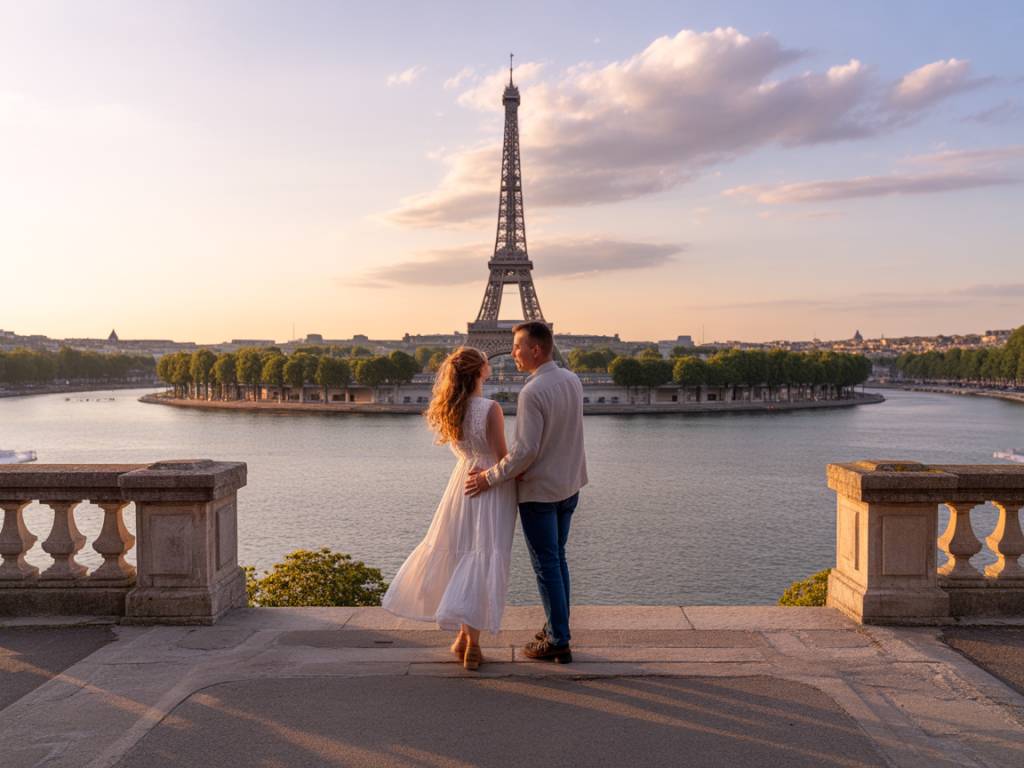
- Highlights: Eiffel Tower by night, cruises on the Seine, museums, hidden passages, bistros, rooftops, day trip to Versailles.
- Budget note: accommodation is expensive. To keep costs reasonable, mix 3–4* hotels and small bistros instead of Michelin restaurants every evening.
Provence (Luberon, Alpilles)
- For who? Relax & chill couples, lovers of pretty villages and landscapes, food & wine enthusiasts.
- Highlights: Gordes, Roussillon, lavender fields (late June–mid July depending on years), markets, rosé wine, sunset over olive groves.
- Practical note: a car is almost essential. In high season, book very early for charming small hotels.
French Riviera (Nice, Antibes, Menton, Esterel)
- For who? Sea & sun couples, but also city lovers (Nice, Cannes), fans of glamour.
- Highlights: turquoise water, coastal walks, hilltop villages (Èze, Saint-Paul-de-Vence), boat trips.
- Watch out: in July–August it’s crowded and pricey. If you can, choose May–June or September.
Corsica
- For who? Sea & sun + nature & adventure couples, who don’t mind driving on sometimes winding roads.
- Highlights: dream beaches (Palombaggia, Santa Giulia), mountains, small coves, boat trips to the Lavezzi islands.
- Budget note: often a bit more expensive than mainland France, especially in July–August.
Loire Valley
- For who? Couples who love castles, cycling, quiet riverside stays.
- Highlights: châteaux (Chenonceau, Chambord, Amboise), wine tastings, bike rides along the Loire, nights in manor houses.
- Best season: May–October, avoiding peak August if you don’t like crowds in the main châteaux.
Bordeaux & vineyards
- For who? Wine & gastronomy couples who want a mix of city + countryside.
- Highlights: tastings in wine estates, nights in vineyard guesthouses, classy restaurants, an elegant city centre in Bordeaux.
- Tip: consider splitting your stay: 2–3 nights in Bordeaux city + 4–5 nights in the vineyards.
Sample France honeymoon combinations by travel style
To help you imagine things concretely, here are a few sample combinations, for a 10-night honeymoon, with realistic pacing.
For city + countryside lovers: Paris & Provence (10 nights)
- 3–4 nights in Paris (museum passes, key monuments, a few neighbourhoods rather than trying to see everything).
- 6–7 nights in a village in Provence (same accommodation base, day trips in the area).
- Good months: May–June, September–October.
- Budget: medium to comfortable, depending on hotel choices.
For sea & villages fans: Nice & hinterland villages (10 nights)
- 4–5 nights in Nice (city, beaches, day trips to Villefranche, Èze, Monaco by train or bus).
- 5–6 nights in a village in the backcountry (Saint-Paul-de-Vence, Vence, Grasse area) to relax.
- Good months: May–June, September.
For gastronomy & wine lovers: Lyon & Burgundy (8–10 nights)
- 3 nights in Lyon (one of France’s food capitals).
- 5–7 nights in Burgundy between Beaune, Dijon and the vineyards.
- Good months: April–June, September–October (for the colours and harvest vibe).
Key practical questions to narrow down your choice
When I préparé honeymoons for my readers, I always come back to these practical questions, because they immediately refine the destination:
- How many nights do you really have? If you have 5–7 nights, avoid trying to fit Paris + South of France + another region. One or two bases are enough.
- Do you want to rent a car? If the answer is no, prioritise Paris, big cities (Lyon, Bordeaux, Nice) and regions with good trains/buses. Provence, Dordogne or some mountain areas are less practical without a car.
- What is your tolerance for crowds? If you hate crowds, avoid the Côte d’Azur and the most touristic villages of Provence in July–August. Choose instead Dordogne, Auvergne, some parts of Brittany or the Alps in June or September.
- Is this your first time in France? For a first trip, a mix like Paris + 1 region (Provence, Loire, Côte d’Azur, Alsace depending on season) is usually ideal.
- What comfort level do you need to feel “on honeymoon”? Some couples prefer a simple but charming B&B and spend more on activities. Others want fewer activities but a beautiful 4* with spa. Be aligned on that.
Budget tips to keep the honeymoon feeling without overspending
Whatever your destination, a few strategies allow you to keep a “honeymoon” level of comfort without exploding the budget:
- Travel in mid-season: May–June and September–October are your best friends in France. Lower prices, nicer atmosphere, easier bookings.
- Mix accommodation types: 2–3 nights in a very beautiful hotel + the rest in more simple but well-rated places.
- Prioritise experiences over quantity: one beautiful romantic dinner + a special activity (balloon, boat, spa) often create more memories than 10 small paid visits.
- Book trains early: TGV tickets can be much cheaper if bought in advance on official platforms.
- Use local markets: they’re perfect for affordable, high-quality lunches (picnics with bread, cheese, fruit, cold cuts).
Your step-by-step checklist to choose your French honeymoon destination
To wrap it all up, here’s a mini step-by-step to guide you from vague ideas to a solid plan.
- Step 1 – Define your couple style Note your top 3 priorities (example: sea + good food + calm / city + museums + nightlife).
- Step 2 – Fix a total budget (excluding flights) Range per 7 nights for 2 (indicative): small 1200–2000 €, comfortable 2000–3500 €, high-end 3500 €+.
- Step 3 – Choose the travel month Check quickly the usual climate of your target regions in that month.
- Step 4 – Decide: 1 base or 2? Under 7 nights: 1 main base. 8–12 nights: 2 bases maximum to stay relaxed.
- Step 5 – Shortlist 2–3 regions Example: May, medium budget, love gastronomy and calm: Loire / Bordeaux / Dordogne.
- Step 6 – Check logistics Look up: access from your arrival airport, local transport, need (or not) for a car, opening periods of the places you like.
- Step 7 – Compare concrete options For each region, imagine a 7- or 10-night sketch: number of nights per place, a few potential hotels, 1–2 key activities. Which scenario makes you feel most excited and relaxed?
Once you’ve gone through this checklist, your ideal French honeymoon destination in France will usually appear quite clearly. And if you’re still hesitating between two options, ask yourselves the simplest question: “Where would we feel most ourselves as a couple?” That’s almost always the right choice.